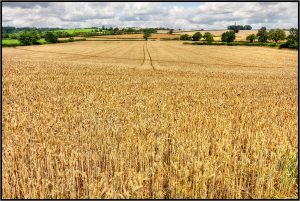
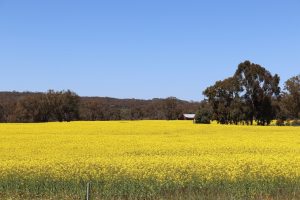
The Australian Bureau of Agricultural and Resource Economics and Sciences (ABARES) released their September Crop Report last week. The good season to date across much of Australia’s winter cropping zone has Australia forecast to produce ample supplies.
The September crop report showed some movement in wheat plantings between states, but overall, this equated to just a 1.1% national increase. It was forecast yields where the main changes were allocated, with good winter rainfall in Victoria, South Australia and to a lesser extent, WA, bumping production higher.
ABARES lifted the forecast yield by 11.7%, or 3.1mmt to 29.8mmt, which would be the 8th largest crop on record, but down 17% on 2025 (figure 1). Lower year on year production can be put down to smaller plantings, thanks to the input shortages in autumn. Figure 2 shows that lower yields in the two largest wheat producing states, WA and NSW, are also to blame for lower national production.
The lower yields in WA and NSW have been somewhat offset by much better yields in Victoria and South Australia. In fact, South Australian growers are headed for their second highest yield on record, with forecasts pegged at 2.93t/ha. The benchmark of 3.34 was set in 2022-23, so SA is some way behind that level.
National barley production saw a 4% increase in plantings on the June report, and the good growing conditions have seen a 16% increase in production forecasts. The barley crop is on track to be the second largest on record.
Canola gained more area than originally projected, with ABARES pegging plantings 8% higher than in the June report. This took canola plantings from a decrease compared to 2025, to a 2% increase, driven by Victoria and South Australia. Figure 4 shows that canola production is forecast to be the third largest on record, and an 18% increase compared to the June forecast.
It’s interesting to note that Victorian canola production is forecast to outstrip NSW for the first time since the 2018-19 drought year. This is due to a large decrease in NSW plantings, and weaker yields in the north.

What does it mean?
We are into September, and it’s not long before headers will be rolling in the north. Crops in the south have some way to go, but subsoil moisture levels are good. With good crop volumes, prices will remain beholden to international grain and oilseed benchmarks. Harvest pressure always strips some basis out when production is strong, which is something that can be managed before or after harvest.
Have any questions or comments?
Key Points
- The September ABARES Crop Report shows higher yields will results from good winter rains.
- Production of wheat, barley and canola are all lower than last year, but up on June forecasts.
- With a good crop, prices will remain subject to international price movements.

Click on figure to expand

Click on figure to expand

Click on figure to expand

Click on figure to expand
Data sources: ABARES, ABS, Wheatcast, Mecardo